Kay Nieselt
Integrative Transcriptomics
University of Tübingen
Faculty in: IMPRS
Vita

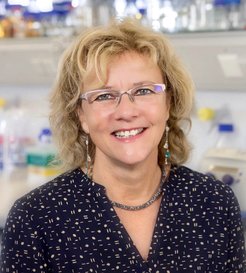
- PhD in Mathematics, Max-Planck Institute for Biophysical Chemistry (Prof. Manfred Eigen), Göttingen, German and University of Bielefeld (Prof. Dress), Germany (1988-1992)
- Postdoctoral training at the MPI Göttingen (1992-1995)
- Feodor-Lynen fellow at the University of Auckland, New Zealand (1995-1996)
- Postdoctoral training at the Zoological Institute, University of Munich (1997)
- Group leader Bioinformatics and Data management, Molecular Cell biology, Max Planck Institute for Biophysical Chemistry, Göttingen (1999-2001)
- Head of the Integrative Transcriptomics Group, University of Tübingen, since 2002
- Habilitation (2014)
- Full professor at the University of Tübingen since 2021
Research Interest
The main focus of the group of Kay Nieselt is on the development of algorithms for analyzing and visualizing large-scale genomic and transcriptomic data mainly derived from microorganisms. The new high throughput sequencing technologies and specific DNA enrichment make it possible to decode the genetic information embedded in human bones and other tissues, such as the DNA of bacterial pathogens. The analysis of DNA extracted from bones or mummified tissues presents a number of computational challenges. To meet these challenges, our group has developed EAGER and MUSIAL, two efficient bioinformatics analysis pipelines which provides the analysis steps necessary for the analysis of ancient DNA. With these pipelines we have successfully contributed to gaining insight into the evolution of historical diseases such as leprosy or pest.
Over the years, our group has worked out the SuperGenome concept, a general global coordinate system for multiply aligned genomes, which has been used to great advantage in a large variety of projects: we developed a new approach to visualize multiple genome alignments (GenomeRing), or to compute and visualize Pangenomes for bacteria (PanGee and Pantetris).
The understanding and analysis of the basic principles of gene expression and moreover gene regulation is still one of the open and unsolved problems in biology. We develop and apply algorithms and tools for the analysis and visualization of large-scale expression data, mainly applied to microorganisms. Besides quantifying gene expression, the identification and/or prediction of transcriptional features is another focus of our research. With TSSpredator we have developed a software for the automated detection and classification of TSS from 5’ enriched RNA-seq data. Moreover, TSSCaptur allows the characterization of TSS signals identified from any 5’ enriched RNA-seq data that cannot be allocated to known labelled genes. It predicts a plausible 3’ end and a function of the transcript. Furthermore, it runs a motif analysis on the promoter regions to identify known or novel transcription factor binding sites.
Visualization plays a major role in bioinformatics. Our group develops various visual analytics tools. One example is Evidente, a web-application that provides an interactive visual analysis interface for the simultaneous interrogation of phylogenetic relationships, genome-wide SNP data and metadata for samples of an organism. Our Omics Trend-comparing Interactive Data Explorer (OmicsTIDE) is an interactive visualization tool developed to address the limitations of current visualization approaches in the multi-omics field. Most of our visualisation tools are deployed on our Tuebingen Visualisation server (TueVis, https://tuevis.informatik.uni-tuebingen.de).
We are involved in a number of research projects within the Cluster of Excellence “Machine Learning in the Sciences”, in the Cluster of Excellence “Controlling Microbes to Fight Infections, and in the transregio TRR261 “Cellular Mechanisms of Antibiotic Action and Production”. Furthermore, we are active members in a consortium that studies the genomic landscape of Treponema pallidum as well as a consortium for the development of a vaccine against Treponema pallidum.
Available PhD Projects
- Currently not recruiting PhD students
Selected Reading
- Harbig T, Fratte J, Krone M, Nieselt K. OmicsTIDE: interactive exploration of trends in multi-omics data. Bioinformatics Advances 2023, 3(1):1-8 doi.org/10.1093/bioadv/vbac093
- Mungan M, Harbig TA, Perez Naybel, Edenhart S, Stegmann E, Nieselt K, Ziemert N. Secondary Metabolite Transcriptomic Pipeline (SeMa-Trap), an expression-based exploration tool for increased secondary metabolite production in bacteria Nucleic Acids Research Webserver 2022, gkac371
- Hennig A, Nieselt K. Efficient merging of genome profile alignments. Bioinformatics 2019, 35(14):i71-i80
- Peltzer A, Jaeger G, Herbig A, Seitz A, Kniep C, Krause J, Nieselt K. EAGER: efficient ancient genome reconstruction. Genome Biol. 2016, 17:60.
- Hennig A, Bernhard J, Nieselt K. Pan-Tetris – an interactive visualization for Pan-genomes. BMC Bioinformatics 2015, 16 (Suppl 11):S3